logo

Project AGI

Building an Artificial General Intelligence

This site has been deprecated. New content can be found at https://agi.io
Showing posts with label AI. Show all posts

Friday, 15 May 2015

Consciousness & "Free Will": The Elephants in the Room

By David Rawlinson and Gideon Kowadlo

The aim of this post is to take a short departure from more technical issues and deal with some of the philosophical questions about Artificial General Intelligence (AGI).

The Elephant in the room

This metaphor implies willful ignorance of something blindingly obvious. Something that's difficult to ignore. It requires effort to avoid talking about it.

While consciousness & "free will" are hot topics for philosophers, most "serious" Artificial Intelligence (AI) literature avoids them (exceptions include 1,2,3). However, I'm yet to meet someone with an interest in AI who hasn't thought about these deep questions (consciousness being the other big one). We just don't talk about them in scholarly company.

The history of AI is a series of speculative bubbles: False hopes, dashed promises and unrealized dreams have created the mainstream perception that AI has gone nowhere for decades. We seem to re-brand AI every 10 years to shed past disappointment. For example, Machine Learning currently enjoys huge popularity, yet half the community do not consider ML to be a subset of AI, viewing the latter as a narrower discipline concerned with symbolic reasoning. A decade ago everything was about explicit treatment of uncertainty.

Today, it is rare to write about “AI” in scholarly journals; we talk about specific approaches instead. AI is tainted terminology.

Having been repeatedly burnt, AI & ML researchers now focus on short-term, achievable goals while (publicly) ignoring questions about fundamental, qualitative distinctions between artificial intelligence methods that already work, and the natural intelligence of people and animals.

Many others make the same implicit distinction, assuming that no form of software has "true" intelligence. When challenged, few are able to describe what is missing; for others the goalposts keep moving. Despite computers being able to drive cars on busy roads, fly on another planet, excel in games, reasoning & insight, perception, fine, adaptive motor control and many other intellectual pursuits, there remains a popular suspicion that this is merely sophisticated trickery and not true intelligence at all!

We have a “God of the Gaps” problem: The qualitative differences between man and machine keep receding into ineffable gaps in machine capability. Humans keep raising the bar.

Physicists have repeatedly proposed (e.g. Penrose) that consciousness requires some special kind of physics. This rationalizes machine inferiority, but seems like an answer in search of a problem without strong prior evidence of such unusual phenomena.

The idea that consciousness requires some form of exceptional phenomena may be a peculiarly Western philosophical trait, resulting from exposure to Descartes' Dualism.

An opposing view is that when properly defined these problems might simply be emergent characteristics of a particular type of algorithm, making the type of physical embodiment unimportant.

The "mere algorithm" claim makes many people uncomfortable, as if it removes part of their humanity or individuality. We would argue it does not. Besides, as the philosopher Daniel Dennett said, "Only a theory that explained conscious events in terms of unconscious events, could explain consciousness at all".

A Problem of Definition

Our position is that the ongoing difficulty with consciousness & free will is simply lack of a satisfactory definition for these features. For those of us who regard Artificial Intelligence as a practical toolkit akin to spanners or wrenches, it's time to hold the less applied thinkers to account. Exactly what performance, qualities or abilities do people accept as demonstrating consciousness?

To improve the specificity of these problems let's replace “Free Will” with Self-Determination and swap Consciousness with Self-Awareness.

Self-Determination

The most problematic aspect of free will seems to be determinism. In a deterministic system the relationship between inputs and outputs is fixed; there are no choices. Instead the inputs determine the outputs. Clearly there is no room for free will if our sensory inputs exactly determine our actions in response.

"Free" will implies that normal causation doesn't apply to thinking - as if it were "free" from any and all constraints. This smacks of a preoccupation with Dualism and the theoretical constraints of hard determinism derived from Newtonian models of the universe. Both Descartes and Newton lived and wrote 300 years ago. We have moved on since then.

A much better description might be "self determination": deciding what to do via some reasoning process, making use of knowledge, experience and personal biases. The big issue is then whether this definition is lacking some essential “freedom” quality.

What if our sensor inputs don't determine our actions, but an unconscious neurological process does instead? Brain imaging suggests that conscious awareness of decisions often occurs long after decisions are actually made and even after action begins. In this model, due to "our" lack of access and control over decisions, free will is merely an illusion. Although this looks hopelessly conclusive, the word "our" is key to unlocking a greater range of more satisfying answers. It is ownership and access that is lacking. We will argue that self-determination restores both.

Self-Awareness

If we are to make our own choices, we need a framework for modelling the world and the values we attach to concepts, events and entities within it. The framework enables us to become aware of ourselves and the world we inhabit.

Consciousness is often described as awareness - of the self, of the past and future, and of the world around. There's also awareness of sensation - Qualia - and an ongoing "stream" of consciousness, such as an internal monologue. Attention - selective awareness - is also entwined with consciousness.

This article isn’t going to be able to describe how to artificially reproduce human awareness. For one thing, evidence from animals and inter-personal variation suggest that the qualities and properties of human awareness are a matter of degree, not a binary feature. Most of the other articles on this blog discuss ways to generate artificial representations of the world from sensory data, but there’s more about current progress in artificial awareness in a postscript to this article.

In contrast, we can ask some pretty definitive questions about the feasibility of self-determination, which will be the focus of the rest of this article.

Models of Self-Determination

Let's explore some thought experiments to see if we can find a set of physically-plausible qualities that fulfill a satisfying definition of self-determination.

Free Will is typically described as the ability to make decisions, or choose actions, in a way that is not determined by external events. In some sense, we are "free" to express personal preference and values over strong external persuasion or evidence.

But Free Will is not simply a random or unintelligent reaction; we would like it to be a choice of some kind. We would like to make informed, deliberate choices that balance our interpretation of objective and subjective criteria: Let our history, knowledge and experiences shape our choices.

A choice without knowledge and understanding is not really a choice at all. Only via an understanding of consequences can we assign value to the choices available. Comprehension of available choices relies on existing knowledge and experience. Execution of decisions requires ongoing, grounded understanding of the world and our action capabilities, to ensure we execute choices as intended. And you're not going to "choose" an action that has no personal meaning - for example, if you live in a desert where it never rains, you won’t invent an umbrella*.

We believe the answer to the whole Free Will problem is also the source of limits to our freedom: Our knowledge, experience and personal values. This is no bad thing: Individual characteristics develop from our personal history, and experience of consequences affects the values we express in future decisions. We don't have to express these limits negatively; we can say that experience, knowledge and beliefs guide us to choices we find reasonable. Personal identity is defined by experience and knowledge and expressed in choices: It’s what makes you, you. And it makes the choices yours.

This is not a new idea. In philosophy, those who believe that Free Will is compatible with some level of determinism are known as compatibilists. Compatibilitists (such as us) believe that the free-will vs determinism debate is a false dilemma that can be sidestepped by clearly defining the objective.

Self-determination is a positive way to summarise the influence of internal constraints. So, if we were to accept these constraints, what freedom do we have, to make choices?

* The etymology of the word “Umbrella” is relevant. It derives from the Latin Umbra, meaning shade. The novel application of an existing sunshade tool to rain protection may be an example of ideas being guided, inspired and yet constrained by previous experience. The adaptation of an existing idea to a new problem is a common innovation technique.

Uncertainty and Stability

The universe we inhabit appears to be mostly deterministic, at human scales, but also quite random, at smaller scales. Some systems, such as weather, are unpredictable at large scales because they are very sensitive to small-scale changes. This phenomenon is known as “sensitive-dependence”: Chaos theory is the study of such systems. A famous example is the “Butterfly Effect”, in which the beating of a butterfly’s wings alters the path of a tropical storm thousands of miles away.

Other large-scale systems are stable against small-scale changes. For example, the behaviour of a brick house or a steel girder does not change significantly in response to butterflies’ flapping. The structure of these systems absorbs these changes, and the behaviour we care about is not affected.

We can easily design information-processing systems to have specific sensitivity to random events. Even simple functions can exhibit sensitive-dependence.

Conversely, we can design robust information processing systems. For example, your computer’s processor can execute millions of instructions per second without error. Nature can do this too: Error-checking mechanisms ensure remarkably accurate copying of DNA into every cell in your body; but mutations do occur at a low but necessarily nonzero rate. Natural selection of some mutations amplifies the frequency of some variants, resulting in evolution.

In Estimation theory, events are represented by a combination of explicit models and terms that capture the effects of random events. We call these random events “noise”. In a sensitive-dependent system, these random events can make the future state of the system unpredictable.

Noise can be selectively amplified or suppressed by carefully designed systems. Complex, large-scale systems can be sensitive to small-scale random events, or they can be designed to be almost entirely unaffected by noise.

Exploiting Uncertainty

For our self-determination model, the ideal solution is a mix of the two extremes. We need deterministic reasoning to accurately evaluate potential actions and outcomes. And we can exploit uncertainty and stability in a system to amplify the consequences of random events when exploring options, and stabilize decisions once made.

Consider perception. You want your senses to reliably tell you what's going on outside your head. This is essential: If all you saw were crazy swirls and flashing imaginary lights, you wouldn't be able to find your way around. But we also want some uncertainty in perception to allow us to test different hypotheses for what we're seeing and decide which fits best. For example, the perception of ambiguous images depends on expectations.

Imagine a scenario with 2 alternative choices: A, and B. Our internally "preferred" choice is A. But perceptual cues and third party advice strongly suggests action B. Let’s assume this "external bias" means that the probability of us even conceiving plan A is small (e.g. 0.1). So in this case it seems that external causes are dominating internal preferences. We're simply responding to external cues, like a puppet. Not ideal.

Now let's change the system a bit. We include a method of repeatedly, randomly generating combinations of ideas, and strongly reinforcing the ideas with the greatest internal value. Imagine rolling a 10-sided die. If we get a '1', we are lucky enough to think of plan A. If we get any other number, we only think of plan B, due to the external bias.

The dice will only roll a '1' rarely. But if we allow ourselves 100 dice-rolls we will get quite a few '1's. As long as we produce a strong response to rolling the occasional '1' (due to the anticipated outcome of plan A), we can design a system that will be largely determined by internal preferences, not dictated by chance properties of the outside world.

This setup is relatively easy to create in software. For example, Arunava Banerjee has designed an artificial neural network that behaves just like this. What’s more, models of human decision-making in the Basal Ganglia appear very similar to the dynamics described here. A recursive, competitive process between competing potential actions are eventually reduced to a set of selected actions that are then reinforced, and executed. A similar process occurs in the Superior Colliculus, the brain component that decides what your eyes will look at.


Figure: An ambiguous image; the same sensory input can be perceived in two ways (in this case either an old or young lady), depending on the prior or internal bias of the viewer.

The Cortex is widely accepted as the origin of high-level, abstract thought, including strategy and planning. In essence, the Cortex provides understanding of contexts and potential choices. The design of the brain routes inter-cortical connections via central hubs - the Basal Ganglia, and the Thalamus. During routing, messages are filtered. This design closely matches the architecture needed for a competitive evaluation of competing plans influenced by an understanding of their consequences.

If the part of your brain that generates ideas is sensitive-dependent, then it can overcome the influence of external factors and suggest all sorts of things until an internally resonating plan is found. Of course, your evaluation of the ideas should be quite deterministic, based on previous experience and knowledge.

Figure: Flow of information from the cortex through deeper structures such as the Basal Ganglia and Thalamus, before routing back to Cortex. This architecture allows deeper structures that filter and select the activity in the cortex. Image from Scholarpedia.

We can predict the weather a couple of days into the future, but beyond that we're no better than random chance at guessing whether it will be sunny. The impact of noise increases over time. Noise in the brain could also lead to vastly different outcomes even given similar initial states.

In just a few seconds of thought, our brains are sensitive and complex enough to generate and evaluate thousands of different ideas. With a little time for consideration, the probability of generating your "preferred" plan may be very high. It’s not the end of the world if this doesn't always happen; sometimes we need expert or friendly advice!

Attributes of Self-Determinism

Let's review the attributes of self-determinism, as defined above:

  • Choices cannot be exactly predicted
  • Demonstrates internal motivations and preference
  • Stable despite irrelevant and/or gross variations in external stimuli
  • Sensitive to external changes that do impact internal value system
  • Consistent perception and decision-making in value-equivalent scenarios
  • Can't decide to do things completely outside our previous experience, although innovation possible via novel composition and extrapolation
  • Values based on previous decisions, lived consequences, experience and acquired knowledge
  • Continuity of experience (i.e. an online learning system)

As discussed above, this form of self-determination requires only a highly tuned, sensitive, but perfectly ordinary physical mechanism.

Retrospective Future Self-Determination!

Sometimes we have to pause and think carefully about things. Sometimes we will mull over a big decision for a few days. Other “decisions” are trivial and are made instantly – perhaps most. But in these cases retrospective awareness of instinctive choices makes us more than helpless bystanders: We can reflect consciously on decisions already made, and re-assess for next time.

Our imagined experience of potential outcomes might modify the values we associate with various actions. We can imagine better outcomes from other choices, that will then be more readily selected in future. In this model, you can improve yourself by conscious reflection on your actions.

Retrospective re-evaluation of actions and consequences allows self-determination even in the face of evidence that decisions can be made before we're aware of them. As long as we later take the time to review the consequences, we can modify the values that will determine future choices.

Conclusion

The issue of free will has profound moral implications: Are we responsible for our actions? The answer is often said to lie in the existence (or otherwise) of a magic property of conscious awareness that allows understanding and decision-making to occur outside conventional physical processes. This process is often called “free-will”: The ability to choose a course that is not pre-determined, but instead a novel and unpredictable response: Chosen, not inevitable. The problem is, we know of no physical mechanism for this type of choice; we would argue that it can't even be defined coherently.

Instead, this article offers a limited but positive alternative to free will as intelligent self-determinism, exploiting both sensitive-dependence and stability via feedback within ordinary physics.

It's interesting to consider our concept of identity in relation to this type of self-determinism. Preferences and emotional expectations resulting from past experiences and personal consequences define our personalities and character via the values and emotional responses we learn to attach to events. This means that self-determined decisions define our identities. We are literally the product of our choices: Your personality is formed by a continuity of experience, choice and consequence.

Having described self-determinism without resorting to special physics or magic beans, there’s nothing to prevent us creating artificial copies of it. We have every reason to believe we can create machines that self-determine their own destiny just as we do. I can't wait to have this debate with one of them.

Postscript

Capabilities of Artificial Self-Awareness

Machines can already construct sophisticated internal representations of the world. Machines can interpret data in ways that have similar qualities and performance to human vision (e.g. how-old.net). So is there anything that fundamentally divides machines' internal representations from the experience of awareness we humans enjoy? Some philosophers call this the "hard problem" of consciousness; other philosophers say the problem doesn't exist, because the missing qualities can't be properly defined or do not really exist! This paradox is best illustrated with the Zombie thought experiment.

The Zombie Conundrum

A philosophical "zombie" is an entity that has the external appearance of consciousness, but internally is merely a simulation of the real thing. In fact, we might all be zombies, depending on the quality of consciousness required for the "real" thing. If you set impossible requirements, then we are all zombies.

Actually, it is easier to prove the veracity of conscious experience in software than in humans. This is because we can “pause” and explore software brains in great detail, with access to all internal state. Given an algorithm that is expected to produce the qualities of consciousness, we can inspect and measure these qualities directly. It might even be easier to build genuine consciousness, than a convincing simulation.

Consciousness may be a continuum rather than a binary feature: Awareness with varying degrees of quality and depth. Chimpanzees deliberately construct tools for later use. Dogs are capable of sophisticated social interactions. So there may not be a yes/no answer to the Hard Problem.

Progress in Artificial Awareness

The purpose of this blog is to look at practical techniques for automatically creating hierarchical, increasingly abstract representations of an embodied, adaptive agent in its environment. There's also some discussion of "symbol grounding" - making the jump between sensory and symbolic representations (we believe the problem goes away when defined as "accumulating invariances" instead).

Persistent belief in the hard problem of consciousness may stem from our inability to imagine both how our awareness would scale down to current computer levels of complexity, and how computer representations would feel when scaled to human proportions.

I find it fascinating to visualize internal representations created by AI, such as the image below. They do seem to capture the essential qualities and variations of broad classes, such as “Cat”. Often, when machines are wrong, their mistakes are reminiscent of the errors made by young children (e.g. “sheeps” or “shoeses” overgeneralization).


Figure: Google trained an artificial neural network (ANN) on stills from YouTube videos. Reverse engineering of one of the resulting neurons reveals this input; it is effectively a self-taught class-label for a common set of inputs. We call this class "Cat". Although the ANN didn't give it a name, it was able to experience this concept. If we had also taught it to speak like SIRI, it is likely the ANN would correctly associate this visual perception with the "cat" word. How is this different to human qualia of Cat?

Wednesday, 25 February 2015

Eric Horvitz on the new era of AI


I found this video interview with Eric Horvitz, the head of Microsoft Research, to be a really interesting window into their work and vision - a large part of which is AI. As Eric states, there is a "growing consensus that the next, if not last, enduring competitive battlefield, among major IT companies will be AI". Very well said.

The full interview, here, is worth the watch.

Saturday, 21 February 2015

Mitigating the perceived future risks of AI


Just a few days ago, Jay posted here about the recent public attention to AI and the potential future dangers that it presents.

Discussion on the topic continues, but it's not all talk. There are at least two institutes focussed on practical steps to mitigate the risks.

There is an institute called MIRI that exists solely to "ensure smarter-than-human intelligence has a positive impact". Founded in 2000, it is non-profit and has many very high profile people on the team, including Eliezer Yudkowsky, Nick Bostrom and entrepreneur Peter Thiel. They publish and hold workshops regularly.

Also, the Future of Life Institute is currently focussed on AI. It recently received a well publicised hefty donation from Elon Musk, founder of Space X and Tesla. As mentioned in Jay's article, Musk is from the camp that believes AI could pose an existential threat to mankind.

Bostrom is director of another related institute called the Future of Humanity Institute, a part of Oxford University.

More of the discussion is set to become practical work and these organisations are leading by example. Usually considerations of the ethical issues lags behind the science. In this case however, due to science fiction and misunderstandings of the technology, the perceived dangers are way ahead of the actual threat. That's a healthy situation to be in to ensure we are prepared.

Tuesday, 17 February 2015

The Real Risks of AI


In the past year or so, there has been a spate of high-profile pronouncements by respected scientists and engineers, cautioning the world about the potential ill-effects of AI. Stephen Hawking, one of the foremost experts on theoretical and astro physics told the BBC that "The development of full artificial intelligence could spell the end of the human race" [1] and Elon Musk, serial entrepreneur and founder of Tesla Motors and SpaceX, told an audience at MIT, that “AI represented an existential threat to mankind [2].”

AI has been around since the 1950s and Hollywood movies like the Terminator have fired the public imagination about rogue AI, at least in the west, where the general public views AI with much suspicion. But the scientific community has always been very cautious about its ability to do anything beyond narrowly defined problem statements, like defeating a grandmaster at chess, as IBM’s Deep Blue did, in the 1990s. AI just a few years ago, was hopeless at tasks that a 6 year old could easily do, like identify people and objects in a family photograph, or communicate with her elderly grandfather, or answer abstract questions about what she wants to become when she grows up.

What is it about AI now,  that is spurring these alarmist statements by respected scientists and engineers?

In the past couple of years, a type of learning algorithm called Deep Learning, has taken the world of AI in general, and Computer Vision and Natural Language Processing (NLP) in particular, by storm. Computer Vision and NLP are both sub-fields within AI; one deals with the science of making computers understand the world around them through vision, and the other deals with trying to make computers understand human speech.

Deep Learning is a learning algorithm that uses a many-layered (hence the word deep) Artificial Neural Network to learn representations of objects or faces (in images) or words, phrases and sentences (in speech) from many known examples, called training data.  Given a new image, it is then able to find and label objects in that image, or understand the meaning of a spoken sentence.

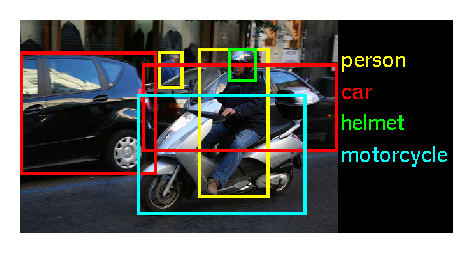
Deep Learning techniques are excelling at pretty much every AI-related application that engineers are throwing at it, and incremental advances in the field that used to take years and decades to achieve, is now happening in months. An illustration of the rapid advances made in the field through Deep Learning can be made through the example of ImageNet. Computer Vision engineers test the competence of each others’ algorithms using large databases of images containing objects, whose positions and labels have been painstakingly labelled by humans, and the biggest of these is ImageNet [3]. ImageNet contains 16 million images and 20,000 object classes, and every year, Computer Vision algorithms are compared against each other based on whether or not they can detect the presence and location of one or more objects in each of those 16 million images.

The sort of labelling a computer vision algorithm is expected to produce, on an example image from ImageNet [4]
   

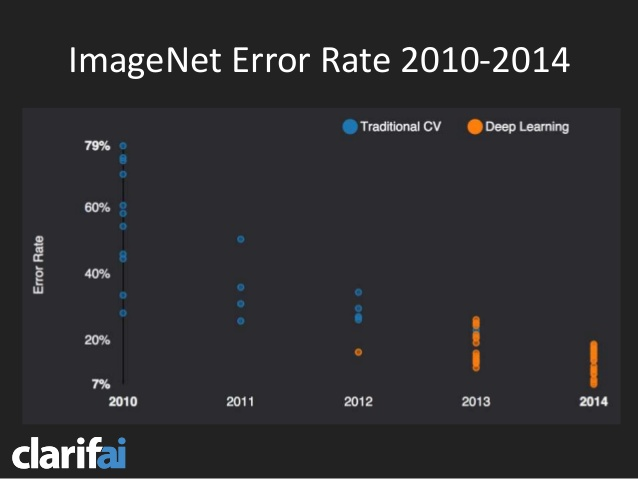
The Error Rate (a measure of the number of labels an algorithm gets wrong on these images, and consequently a measure of the competence of an algorithm) has dropped precipitously since the introduction of Deep Learning algorithms into the competition, from about 40% in 2010, to 6.7% in 2014, by Google’s Deep Learning algorithm, called GoogLeNet [5], named after Yann Le Cunn, one of the pioneers of Deep Learning research. This is a big deal in the field. The improvement per year, every year prior to that in the previous decade on ImageNet and similar databases had been about 1-2%. Engineers were using what were known as hand-engineered features and making very small, incremental advances. Image features are statistics of how objects and parts thereof look like on a pixel level and are supposed to be invariant to changes in viewpoint, lighting, etc. and engineers had been manually designing them for the better part of a decade.

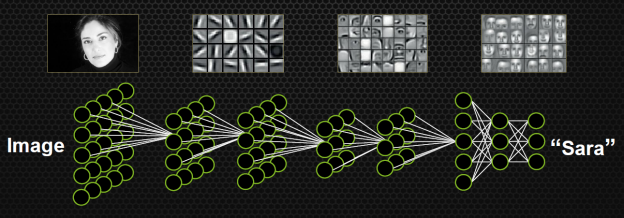
A Convolutional Neural Network or CNN (a particular kind of Neural Network where the first few layers are Convolutional or averaging layers) learns to identify a face using a series of representations whose levels of abstraction, from edge-like segments - to face parts, ears, noses, mouths, etc. - to full faces increase through the layers of the network [6]


Suddenly in 2012, Geoff Hinton and his team from the University of Toronto, used a Convolutional Neural Network or CNN (a particular kind of Artificial Neural Network that also uses Deep Learning techniques) that learnt its own features, and doubled the performance of the 2nd best team that used conventional, hand-engineered features [7]. By 2014, almost every competing algorithm in the competition was a CNN-Deep Learning based algorithm, and the latest error measures of about 6-7% are closing in on the human error rate of identifying objects in these images, of 5% [8].

The error rate on Image Net - over the years [9]


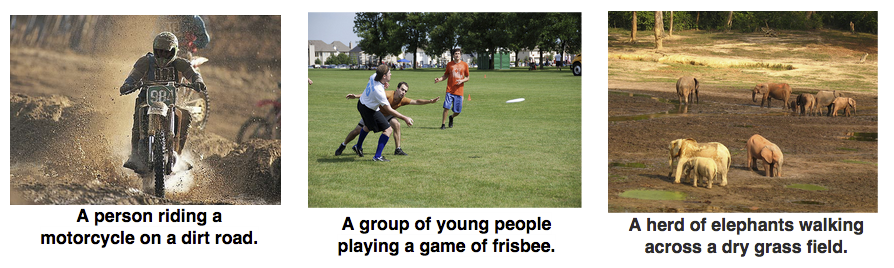
Not only can Deep Learning algorithms determine the type and location of objects in a scene, but they have also been shown to develop a relationship between those objects, i.e. a semantic understanding of the scene [10].

semantic_scene_understanding.png
Semantic scene understanding using Deep Learning [11]


These algorithms are remarkably versatile. Instead of designing specialist algorithms, one for each class of AI problem, as had been done throughout the 90s and the first decade of this century, engineers are using the same Deep Learning algorithm for other problems like medical diagnosis [12, 13] and Natural Language Processing (NLP), alongside Computer Vision. Speech recognition using this technique has shown similar improvements (of about 30% in the error rate), and an astonishing demo of Microsoft’s Chief Research Officer speaking to a Chinese audience in English, while his speech is instantaneously machine-translated into a Chinese voice is available on Youtube [14].

Some of the factors driving this exponential improvement in the capabilities of Deep Learning algorithms now (Neural Networks on which they are based, have been around since the early 80s) are:

  • more data to learn from (billions of images and video, some labelled, but mostly unlabelled from the internet)
  • unsupervised learning - previously, image recognition algorithms learnt from a large amount of labelled data, but versions of the Deep Learning algorithm (auto-encoders [15] and Restricted Boltzmann Machines or RBMs [16]) figure out the labels from the data itself - the Google “cat classifier” [17] for example, learnt what a cat was by looking at millions of youtube videos. It wasn’t told which videos had cats in them. Labelling data is a slow, error-prone and painstaking process, so an ability to learn from unlabelled data is critical.
  • significantly more computing power available today (compared to the 80s and 90s, when Neural Networks were previously in vogue), is able to train networks with many more (deep) layers, and the fact that unlike a regular Neural Network, all the neurons in one layer of a CNN (and other modern Neural Network topologies) are not connected to all the neurons in the next layer, which makes training them faster and easier. Clusters with tens of thousands of processors are now being used for Deep Learning - Google’s cat classifier had 1 billion neuronal connections.

http://m.eet.com/media/1160839/googlecatface315.jpg
An “average” cat image, learnt by Google’s cat classifier [18]


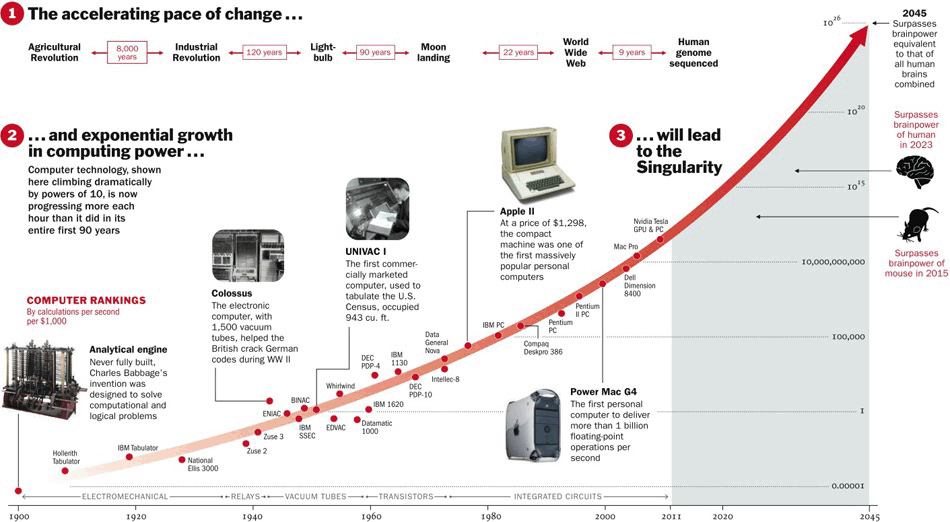
The exponential growth in Computing Power for 110 years [19]


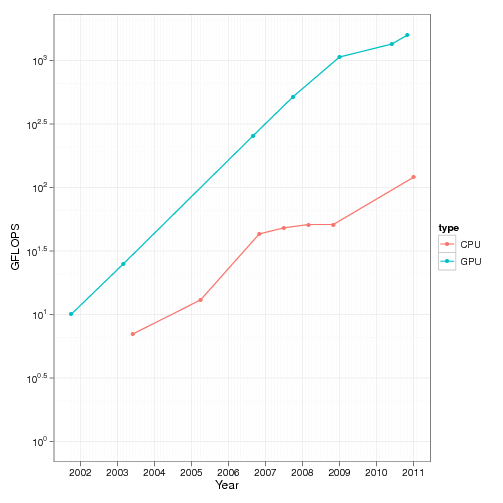
  • The ability to harness Graphics Processor Units or GPUs, whose growth has been accelerated by the computer gaming industry, is another recent advantage. A GPU is traditionally used by a computer to render images and has only recently been co-opted for parallelizing Deep Learning algorithms. GPUs, with thousands of processor cores (as opposed to a handful in the CPU), can process in parallel the thousands of pixels or pixel-groups in an image - a CPU would have to do that sequentially - drastically speeding up the learning process. The Google learning system required 1000 computers and cost 1 million dollars to build, whereas a similar system was recently built for 20,000 dollars, using GPUs on just 16 computers [20].

GPU growth (in terms of the number of floating point operations per second - FLOPS - has surpassed CPU growth in the last decade [21]


Quantum Computing, another field that is slowly taking off, is another reason why this exponential growth in the performance of these algorithms is set to continue. Regular computers store information in the form of binary bits, which can be either 0 or 1. Quantum computers, on the other hand, take advantage of the strange laws of Quantum Physics, and store information in Qubits, which can be both 1 and 0 at the same time. This is especially useful in solving one specific type of problem, called optimization. Most learning algorithms, including Deep Learning algorithms need to perform optimization, the task of finding the minimum in a “landscape” whose peaks and troughs represents a cost function that describes the learning problem, which could be learning how to recognize a particular object in an image, or a word in an audio recording. Typically, this landscape is big, and multi-dimensional, and it is not possible to search each part of the landscape exhaustively in a finite amount of time. Instead, algorithms explore a few candidate hills and “walk” down to the valleys closest to them, and the lowest point amongst these valleys is taken to be an acceptable compromise.

A classical computer with a sequential algorithm can explore only one part of this optimization landscape at a time. Because there is no time to exhaustively search the entire landscape, algorithms using classical computers, using the “compromise solution” often get stuck in a local minimum, a local valley, that might not be the absolute lowest point on the landscape. Thanks to superposition, the possibility of the qubits being both 1 and 0 at the same time, an algorithm running on a quantum computer is able to explore multiple points in the optimization landscape simultaneously and find the real minimum much more quickly than a classical computer.

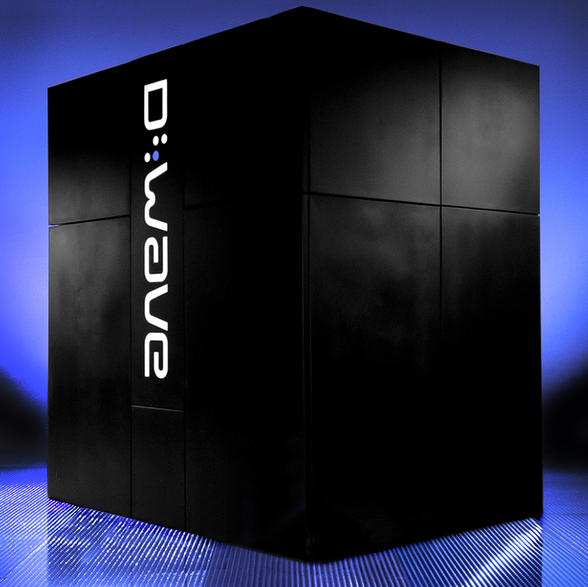
quantumComp.png
A quantum computer from DWave [22], reminiscent of the black “monolith” from 2001, A Space Odyssey


It is this exponential advance in the capability of AI, likely to be sustained in the coming years by GPUs and quantum computing, that has eminent scientists worried. However, long before some of the humanity-ending, doomsday scenarios that are being bandied about have any chance of becoming a possibility (scientists disagree on the amount of time it will take for AI to become self-aware and surpass human intelligence - estimates vary from decades to centuries), there is a much more immediate problem. This is one of job-losses and the subsequent social upheaval, brought about by AI algorithms and machines that are very good at doing some of the jobs done by humans today.

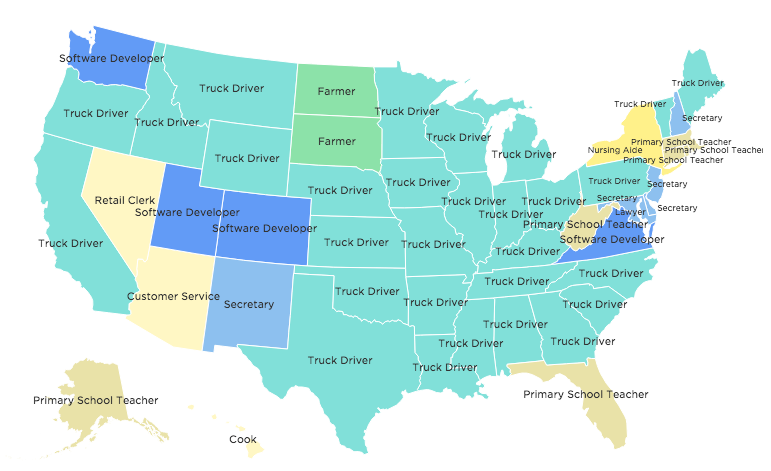
commonJobsByState.png
The most common jobs in the U.S. in 2014 - truck driving is the most common job in a majority of states [23]


Like driving. Google’s autonomous cars have been zipping around the laneways and highways of the Bay Area for some time now, and Google is now looking to team up with major players in the auto-industry to bring their autonomous cars to the market within the next 5 years [24]. Uber, the taxi-company that pioneered real-time ride-sharing - users use their GPS-equipped smart-phones to hail cabs and share rides, has just announced a collaboration with Carnegie Mellon University to bring autonomous taxis to the market [25]. You would use your app to hail (and possibly share) a ride on an autonomous taxi, just like you do today, on human-driven Uber taxis.

Self-driving cars, driven by never-tiring robots with eyes in the back of their heads (actually the cars ARE the robots - equipped with sensors and AI software) have the potential to completely disrupt the taxi and trucking industries (truck driving is the most common job in the U.S. today - see above figure). Highway driving is easier than city driving (in spite of the higher speeds, highways are constrained environments and there are fewer things you’ve got to look out for) and autonomous driving on highways was in fact demonstrated much earlier, in the mid 90s [26], and is likely to get over the legal hurdles quicker.


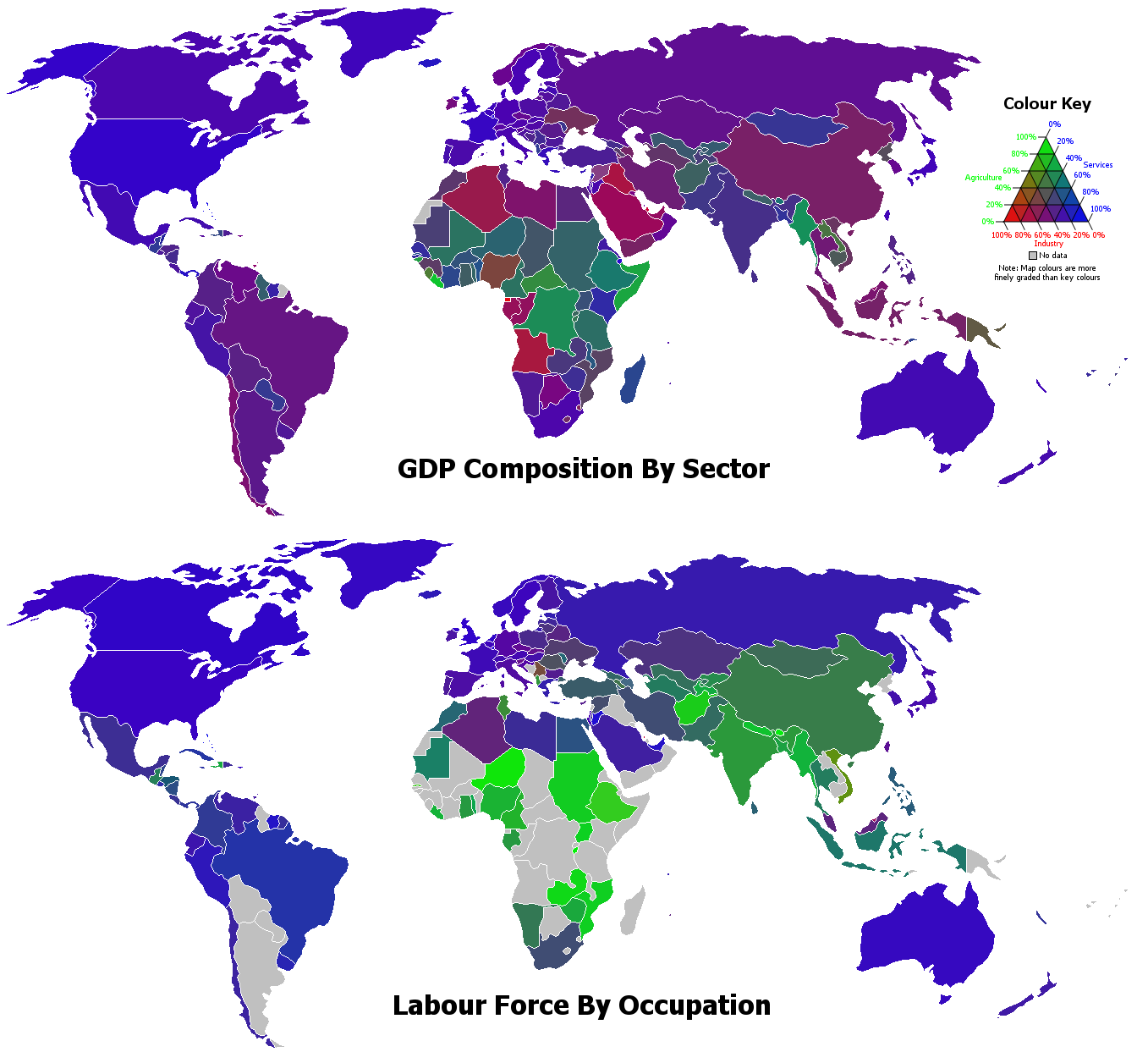
The services sector (blue), that occupies a major chunk of the employment pie in developed economies is most at risk from AI [27]


Drivers are part of the services sector, and it is their jobs, along with others in the service industry, that occupies a disproportionately large slice (80%) of the employment pie in advanced economies (dark blue in the above figure). It is these jobs that AI is currently getting better than humans at, and where there is the biggest potential for disruption [28].

This upcoming upheaval in the labour market is different from the changes in productivity (and resulting fall in employment) during the industrial revolution in the 18th and 19th centuries. Change during that revolution was more gradual, allowing workers 50 years or more to transition from hard, manual labour to less labour-intensive jobs in mills and factories, whereas current trends indicate an exponentially increasing capability for AI to take over the services jobs - jobs that form the backbone of western economies - within the next 10 years.

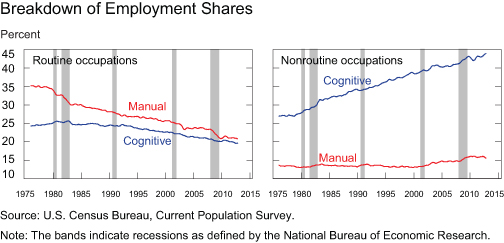
Employment trends in the US since 1975, divided between routine and non-routine jobs [29].


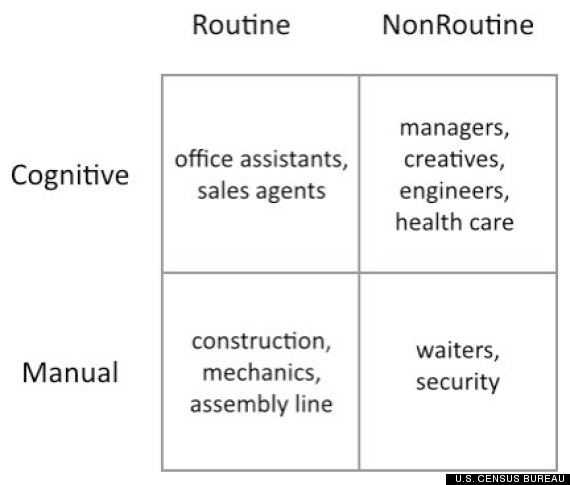
Even before these latest advances in AI, the job market in advanced economies since the 1970s has been increasingly polarized, with job growths at two ends of the spectrum - highly skilled, non-routine jobs for engineers, managers and medical practitioners and low skilled, non-routine jobs that require physical activity, like waiters, mechanics and security guards. This is at the expense of jobs that are routine and repetitive, involving following a pre-defined set of instructions - a lot of assembly-line work for example, has either been replaced by automation, or moved to lower income countries.

Economics researchers at the New York Federal Reserve have broken down the job market into the following matrix, with routine and non-routine jobs that require cognitive vs manual skills.

Job matrix: the employment market broken down into routine and non-routine jobs that require cognitive vs manual skills [30]


They’ve analyzed data that demonstrates that non-routine jobs which require cognitive skills have been increasing compared to non-routine jobs that require manual skills, and routine jobs that require cognitive and manual skills have both been decreasing.

I would further divide routine, manual jobs into ones that involve dextrous manipulation and some skill, like that of a technician or a mechanic, vs the manual jobs that don’t require these things - picking and placing and sorting of parts on an assembly line in a factory. With robots yet to achieve the levels of dexterity of humans, the latter class of job is disappearing much sooner than the former.

Now, let’s look at the top 10 occupations in Australia (a typical advanced Western economy, and a country I’m familiar with, given half a lifetime spent there), sorted according to the number of people employed in decreasing order [31], and classify them according to the above matrix.

Sales Assistants (General): routine, cognitive
Registered Nurses: non-routine, cognitive and manual
Retail Managers: non-routine, cognitive
General Clerks: routine, cognitive
Receptionists: routine, cognitive
Accountants: routine, cognitive
Commercial Cleaners: non-routine, manual
Primary School Teachers: non-routine, cognitive
Accounting Clerks: routine, cognitive

At risk from AI are jobs for Sales Assistants, General Clerks, Truck Drivers, Receptionists, Accountants and Accounting Clerks - that’s 1.4 million out of 2.2 million jobs in the top-10 list. In other words, more than half of Australia’s most popular jobs are at risk of disappearing over the next decade, and this figure is roughly the same for other developed economies as well.

What will these people do, and how will they earn a livelihood? Thankfully, it is not all bad news for employment in the developed world, and there are a number of ways in which AI is also likely to generate new employment, and the industry where this is most likely to happen is healthcare.

640px-DeepQA.svg.png
High-level architecture of Deep QA used in IBM’s Watson [32]


As populations in industrialized economies age, a far greater share of their GDP will be employed in ensuring the well-being of their people (The U.S. spent 18% of its GDP on healthcare in 2012 [33]). However, the numbers of doctors and physicians either in practice today or in training for the future are nowhere near the numbers required to take care of an ageing population. The solution could be to use AI systems, like IBM’s Watson, to help medical assistants take over some of the primary health-care duties of physicians.

Watson, a Deep QA (Question and Answer) system named after the company’s founder, can understand a natural language query (a question you would pose to a person, as opposed to one tailored to find answers on a search engine), search very quickly through a vast database and give you a response, also in a natural language format. Watson shot to fame in 2011, when it defeated two former winners of the TV game show Jeopardy, where participants are quizzed on a variety of topics with questions that are “posed in every nuance of natural language, including puns, synonyms and homonyms, slang and jargon” [34]. Watson is designed to scan documents from a vast corpus of knowledge (medical journals for example) very quickly - currently at the rate of 60 million documents per second - and come up with a range of hypotheses for a question, which are then ranked based on confidence and merged to give a final answer, also with a confidence level associated with it.

Given a set of symptoms, a system like Watson would be able to list out the top diagnoses, ranked in terms of confidence. These diagnoses relying on information gleaned from a far larger database that a human mind can ever learn in a life-time, and improving all the time (Watson, like Deep Learning systems, is a continually learning system that improves with feedback), would be free from something called the anchoring bias, a human tendency to rely on a limited number of pieces of evidence that account for the symptoms and discount everything else [35]. It will enable an army of physician-assistants, nurses and nurse-practitioners to administer primary health care, and free up physicians and doctors to do other things that require a higher level of skill.

So, the large numbers of middle class job losses in the services industry could potentially be replaced with jobs in healthcare.

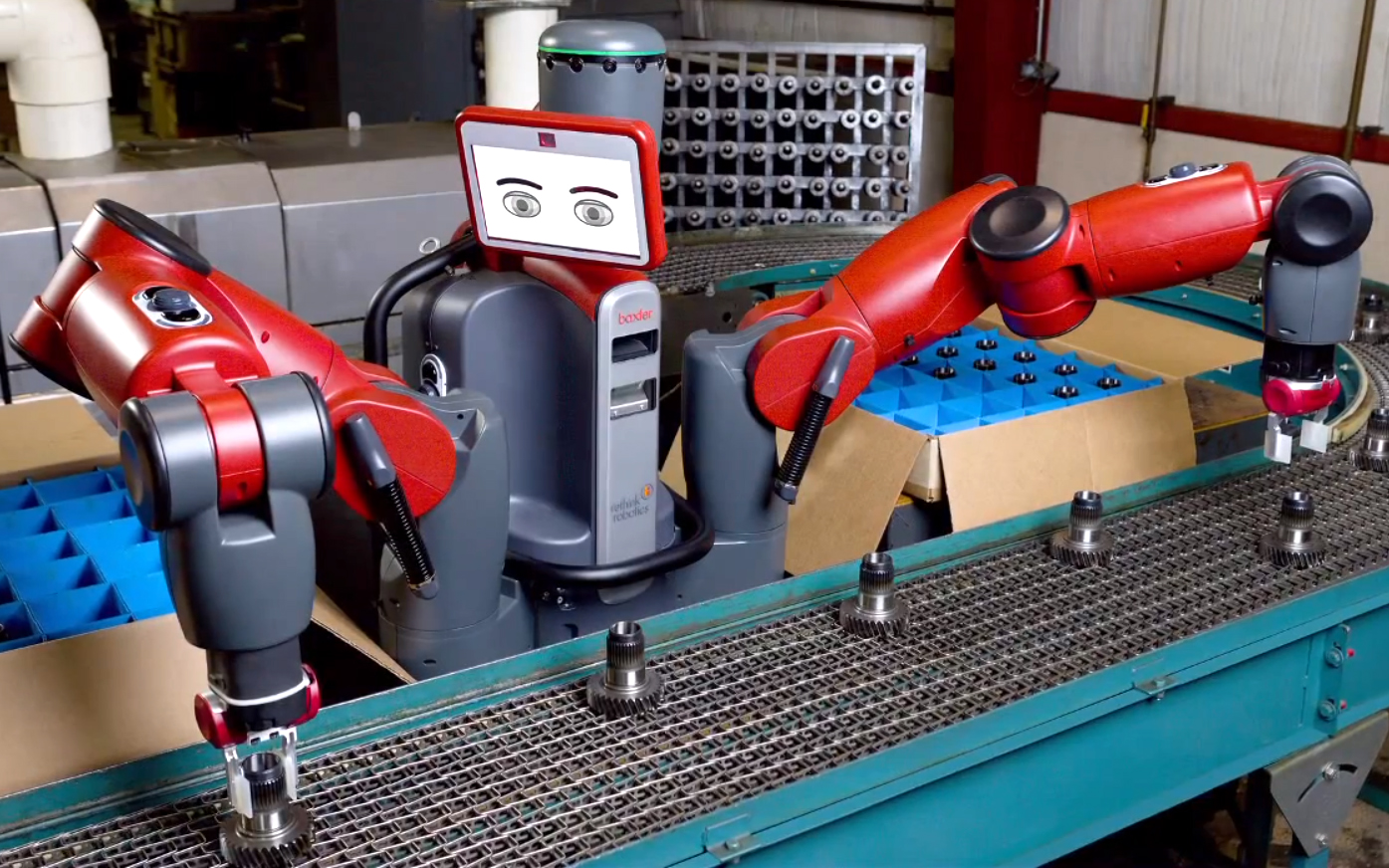
The Baxter manufacturing robot [36]


AI and robotics is also, ironically likely to create jobs in manufacturing, after previously having taken away some of those manufacturing jobs. The previous generation of robots that replaced humans, in automobile manufacturing for example, were huge and unwieldy, and unsafe to be around - they had to be installed in cages to prevent injury to their human co-workers. Requiring experts to program, they were efficient in one specific type of task, like spot-welding or spray-painting, but once programmed, were not able to deviate from their pre-programmed routines. A new generation of manufacturing robots like Rethink Robotics’ Baxter is smarter, smaller, and safer to be around, because it can sense and interact with humans around it. Baxter can be trained interactively by someone who does not need to be a robotics engineer - the robot is hand-guided to perform a series of movements in response to sensor inputs - and can be quickly reconfigured to perform different sets of tasks.

Repetitive assembly line work like putting together the components that go into making an iPad, or stitching together fabrics to make a garment, work that has largely gone to the developing world in the past 30 years, is likely to come back to the West, thanks to robots like Baxter. Small to medium enterprises, with a smaller, but smarter workforce, armed with their robotic assistants, will be able to turn out custom-made consumer electronics and compete with devices mass-produced in China.

AI is also likely to create new jobs that we are unable to predict today, just as the rise of Information Technology gave rise to software developers and data analysts, jobs that didn’t exist just 30 years ago.

Over the next decade, it is very likely that AI will result in an unprecedented churn in the job market, and potentially threaten the livelihoods of hundreds of millions of people in the developed world. Protectionism or government regulation against AI will only delay the inevitable, because ultimately, the economic gains to be had from AI will outweigh the negatives.

The increased productivity and revenue from increasing levels of automation brought about by AI in developed economies could be used to provide Basic Income, a guaranteed minimum income to all citizens. Such an income would help people weather the storm of unemployment and would have the added benefit of allowing people to pursue activities out of interest, and not out of economic necessity.

However, governments and policy makers need to be informed and cognizant of the disruptive power of AI and craft policy to help their people deal with it. Otherwise, they will be left confronting a situation of mass-scale unemployment and social unrest that will make the Global Financial Crisis look like a walk in the park.